There seems to be a tension between technology and spirituality.
It’s almost like a paradox - we’ve built the AI that can think and talk, we’ve built social media to connect us more than ever, and we’ve built apps with infinite feeds which magically show us clips which are the most likely to keep us hooked. Yet, spirituality feels like it’s the opposite of such technology.
While modern consumer technology is geared towards efficiency, connection and the curation of endless information, spirituality is more about letting go, of digital detoxes away from such technology, of clearing the mind and freeing the soul.
Thus, the phrase “spiritual technology” sounds like an oxymoron until you remember that every spiritual tradition began as a technology.
Prayer beads and mantras served as a user interface for nurturing attention.
A rosary is a technology. A temple is a technology.
The printing press allowed sacred texts to proliferate beyond the monastery walls. The radio and television brought gurus and preachers into millions of homes.
Meditation, journalling, hypnosis - technology that we’ve slowly iterated on for thousands of years - ended up eventually silencing skeptics as science itself caught up to verify their benefits.
Every new medium carries spiritual potential. Once the novelty fades, it’s inevitably used to explore the oldest questions: Who am I? Why am I here? How can I be better?
I think these questions, which people eventually consider to be the most important questions of life as they get older and wiser, are going to matter more as we all stumble towards superintelligence.
If AI solves our material needs, the only domain left is the inner world.
Even without superintelligence, a future in which we’re all operating at a higher plane of awareness, less at war with our inner selves and more at peace, is a future worth striving for.
This is why I believe we can turn the tools around. Use state-of-the-art technology to build what I’m calling Spiritual Technology: technology designed to upgrade the subconscious, the emotional and intuitive parts of us that run beneath conscious thought. Technology as a mirror rather than a slot machine. Technology that improves our lives and enables us to improve the lives of those around us.
That is why I’m building Drift Inward.
II.
I started working on Drift Inward earlier this year as an experiment to answer a question: how far can I push today’s AI to make myself genuinely better?
There are very few complete products out there addressing this need with AI. Self improvement, mindfulness, self mastery - all these are where the most important technology of our time should be deliberately deployed, and yet, there’s almost none. What’s out there are simple single-use apps or gimmicks that don’t actually work.
Drift Inward actually works.
It works for me, and it works for other users who are paying for it already, despite me just doing minimal marketing for it.
If you visit the landing page of Drift Inward - you’ll see that it’s composed of two primary actions - AI Meditation & AI Journalling.
Meditation and journalling aren’t the only things on the app (there’s a LOT more), but they’re the core of what makes Drift Inward effective and magical.
Unlike other mindfulness apps like Calm and Headspace where meditations are generic (and they paywall these generic tracks while all generic tracks on Drift Inward are free), Drift Inward creates specific meditations just for you.
Based on your unique circumstances, the context you provide about yourself, and even adding your journal entries as context, each meditation is carefully designed to do exactly what you expect it to do.
Have a big day at work tomorrow and need to sleep? Describe it and let Drift Inward create something that lulls you there. Need to calm down after a difficult day? Need to process anxiety? Need someone to tell you it’s going to be okay? Write it down, put your headphones on, and let the app guide you through a meditative experience designed for precisely where you are.
I can’t get enough of custom meditations and have been using it after every journaling session, but where it gets wild is the “Deep Hypnosis” feature. These are significantly longer audio tracks designed to take you into a hypnotic state and in that state. It delivers exactly the suggestions you asked for - injects them into your subconscious, while gently guiding you out of the state once you’re done.
You have to experience it to believe it, but I believe it’s one of the most novel use-cases of AI as it gets better at superhuman persuasion - something that’s been hinted at gloomily by AI lab CEOs, who aren’t really considering the upside it has to offer.
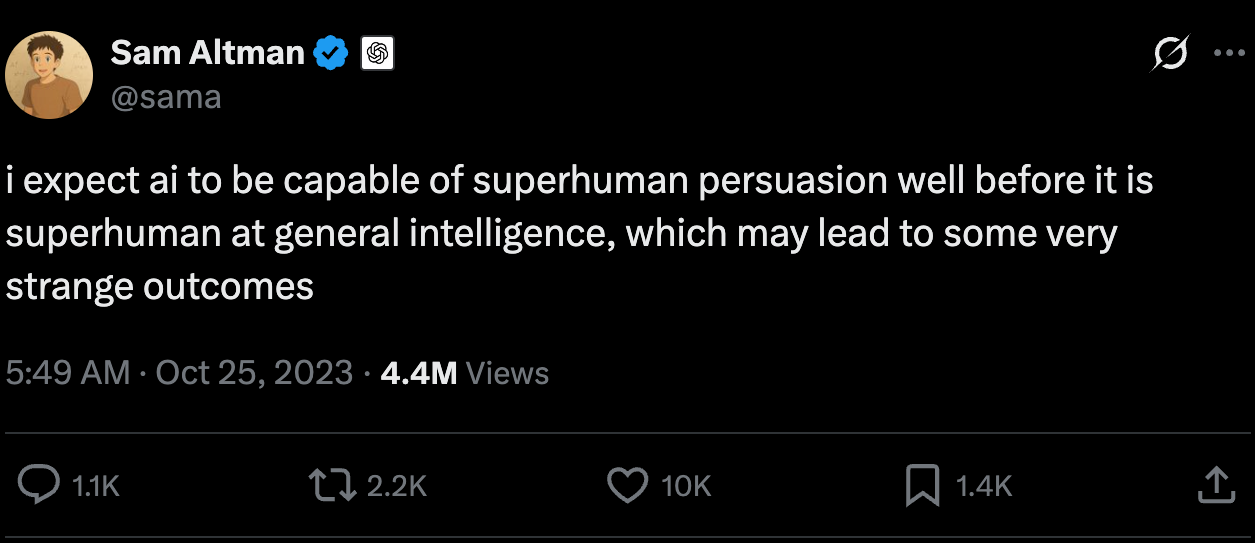
Obviously as capabilities improve, an AI more intelligent than anyone on the planet will be more effective than any hypnotist.
It’d know the right combination of words that precisely work for you, and it’d know exactly what to say to you to help you achieve whatever goal you give it.
Powered by the context in your journal entries, every deep hypnosis is already the most personalised hypnosis session you can experience. Physical sessions with a trained hypnotist might be better for some use cases, but I believe the future of subconscious engineering shouldn’t involve a person.
Rather, everyone should have an always-on, always-available AI that has just the right context to deeply know you better than anyone else, and thus, tell you exactly what’s engineered to be maximally effective just for you.
Now, let’s talk about the AI journal.
III.
I’ve described the journal as something that powers personalized meditation, but that undersells it.
While building the journal, I wanted something I’d genuinely enjoy filling each day. Something that leverages AI to uncover patterns. Something that measurably improves my life.
To this end, the AI journal shows you realtime insights based on Cognitive Behavioural Therapy using AI- as you type in the journal.
It doesn’t break your flow state.
At any time you can stop typing, can open up the insights panel and check out if you’re having any negative thought patterns, cognitive distortions like catastrophizing, black-and-white thinking, rumination loops - all science-backed techniques to get the most out of your journalling practice.
Slash commands let you go deeper. Type “/” and a radial menu appears: ask for reflection prompts that push you further, generate actionable next steps, or reframe what you’ve written with optimism. All without lifting your hands from the keyboard.
There’s also a gratitude streak. The AI analyzes what you’ve typed, and once you’ve expressed gratitude, a small heart lights up. I built this because research consistently shows the benefits of regular gratitude practice- this makes it effortless to maintain.
All this is just a tap away, so that you’re never taking your hands off the keyboard.
Speaking of positivity, there’s a gratitude streak built in, where AI constantly analyses anything you’ve typed and once you’ve expressed gratitude, the gratitude heart lights up.
I built this because I’ve read a ton of research showing the benefits of expressing gratitude regularly, and this is the perfect way to make that a daily practice.
Overall, I’m pretty happy with how the journal works now, but I’m not done yet. I have several important features planned for the journal that’d make it 10x more powerful and enjoyable in the coming months.
The thesis of the journal is simple - we don’t know what powerful features future AIs will be capable of. But we need to be prepared to make the most of it.
Maintaining a journal now would let us leverage the models of tomorrow more effectively than we can even imagine right now. Today, it’s already powerful enough to design just the right meditations and hypnosis sessions - capabilities that will only keep improving.
As models get better - I can imagine features like the AIs showing you exactly what’s the right career for you, exactly what habits you should cultivate that will uniquely make you better, exactly what decisions you should take today to achieve your goals. While they do that right now quite well, if we imagine future AIs as vastly more intelligent than us, advice on Drift Inward would be drastically more effective than any generic advice on ChatGPT or other apps.
That doesn’t happen without a considerable investment in the practice of journalling itself, but with the right agentic harnesses and context systems in place - this will be one of the most powerful and effective AI experiences we can build.
IV.
Drift Inward would be perfectly fine if it just had AI meditations and AI journalling.
But there’s more - a mood tracker to consistently track your mood, a chat where you can chat with three different AI guides (and yes, you can use your journal entries as context here as well) but there’s one other section called the Discover section - which seems counterintuitive at first.
The Discover tab has AI Astrology, AI Tarot & AI Numerology. Now, in an app that’s so closely tied to science-backed tools like meditation and journalling, what does it also have ancient practices like Tarot & Astrology? Shouldn’t they be separate apps?
No. And here’s why.
The discover mode, is (aptly titled) to help you discover. Discover new possibilities. Discover yourself. Discover what works, and what doesn’t.
I think ancient practices & symbolic systems that have survived thousands of years, despite the skepticism associated with them, have done so for important reasons.
I’m not claiming that someday science might catch up to hidden secrets that our less-distracted ancestors discovered when they came up with such symbolic systems, but what I’m claiming is this - using technology to engage the subconscious when we gaze into symbols and try to find meaning in them is useful.
There’s less “conscious” logic involved when you’re trying to understand what the position of planets or the symbols in a tarot card mean for you today - but in suppressing the conscious, you unlock the powerful subconscious to do its thing.
That itself seems worthwhile to me, and if future powerful AIs, with the context of your life, can come up with readings that help you imagine new possibilities, or just live a little better - I think that’s worth it.
I’ve seen extractive apps in this category - apps which claim that their predictions are true, and Drift Inward is never going to do that. All readings are personalised to you by default - and you can believe as much or as little as you try out these features.
To truly upgrade your subconscious, we must engage it deeply - and that’s what the Discover tab does.
A user recently emailed me saying that the tarot helped them see something in a new way that they had never noticed before, and just that ended up unlocking something beautiful in their lives.
Another user told me that exploring his birth chart readings made him more conscious of his finite time while also helping him plan more deliberately. I think testimonials like these will become more common as AI gets better at delivering readings that resonate.
This is what good divination tools have always done, regardless of ontological commitments: it creates sacred randomness that you interpret, and in interpreting, you reveal yourself to yourself. With AI, all of that feels even better.
V.
A final word on the design - I’ve designed Drift Inward to feel beautiful and calm.
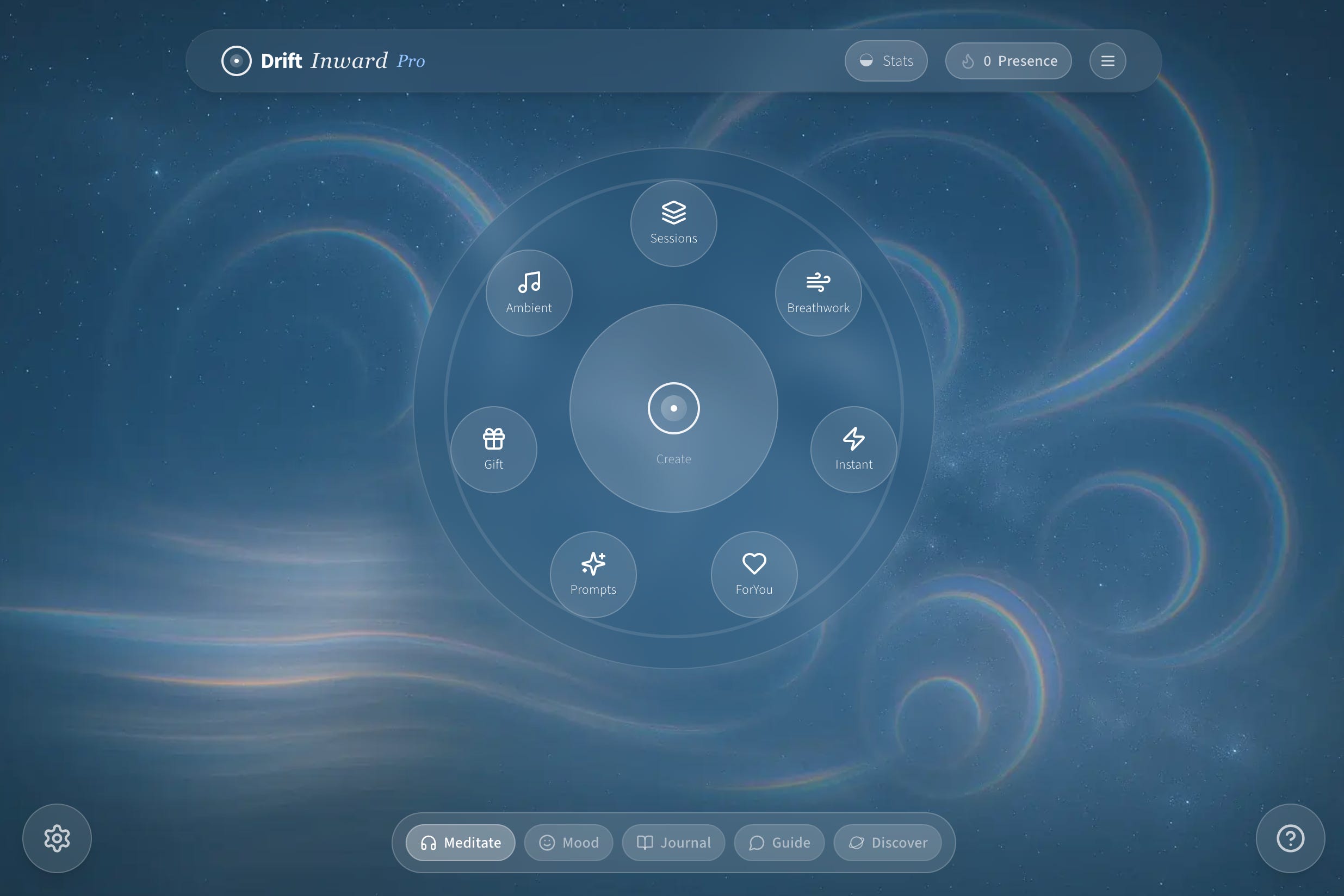
Other mindfulness apps feel like spreadsheets of audio tracks while Drift Inward creates its own vibe with the Living Dial interface.
The spiritual journey isn’t linear- it’s cyclical, recursive, a spiral we walk again and again with slightly different eyes each time. The circular dial reflects this. There’s no endless scrolling, no hierarchical menus- just a simple, beautiful interface that puts what you need one conscious click away.
The wellness app economy runs on a simple model: acquire users, extract data, optimize for retention, raise the next round. Drift Inward runs on a different logic entirely. No investors. No pressure to scale to a million users. No false promises.
Drift Inward will never sell your data, and being already profitable while bootstrapped means it’ll scale sustainably without dark tactics. I made Drift Inward alone with my own hands, and it already has more features than any other wellness or mindfulness app out there while being significantly cheaper.
There’s a lot of features I couldn’t talk about in this essay that I’ve left for you to discover (like, how you can change the background ambient music of every meditation track from the settings, and how you can track your distractions and be more mindful about them, and a new take on streaks that isn’t annoying or judgemental).
This is spiritual technology: not technology that replaces the inner journey or distracts you or extracts from you, but technology that actively supports you in all your endeavours. A guide you can carry with you. A mirror that remembers.
With your support, I believe we can build one of the most powerful spiritual technologies ever created- something that upgrades your subconscious and helps you become who you want to be.
See you inside Drift Inward.
_____
Drift Inward is available now on iOS and on web at www.driftinward.com
For a limited time and exclusively for all early users, the price of every plan is 50% off. If you sign up for a paid plan today, you’ll keep the discounted price forever. I’ve tried to keep it as affordable as possible - The plus plan just $7.99 a month, or $84 a year, and gives you full access to all premium features.
You can absolutely try Drift Inward for free, and there are tons of free features that even rival popular meditation apps like free tracks, unlimited journalling, 3 free AI meditations - but to enjoy the premium features like deep hypnosis and voice journalling, it’s $7.99.
I’d love for you to try it. I’m building this in dialogue with the people who use it, and I’m always available for feedback and feature requests!